Council members fret over public arts reductions in city bond proposal

Out of the nearly $45 million in changes a series of citizen committees recommended to the upcoming bond program, cutting the portion set aside for public arts by $3.8 million grabbed the most attention on Wednesday.

The city is preparing to put a $1.2 billion, five-year bond program in front of voters for the May election. As part of the process to determine what will be included, the city relied on five committees comprised of council appointees for recommendations.

While the majority of the bond program is for large projects like streets, parks, city buildings, and drainage, a small portion is set aside to pay for public art projects.

In 2017, 1% of the total bond, excluding the portion for neighborhood improvements, was set aside for that purpose. This time, city staff and city council had proposed raising that to 1.5% of each portion of the bond program, excluding housing – about $15.7 million in all.

However, as the bond committees tried to prioritize projects for this bond program, some of them turned to the public art allotment as a way to stretch their portion of the bond further.

The parks committee recommended taking $1.3 million out of its public art allotment, knocking that section down to 1%. The drainage committee went even further and slashed the entire $2.5 million of public art dollars from its recommendations.

As a result, the remaining $11.8 million in public arts funding worked out to a 1.1% average of the non-housing portions of the bond.

District 10 Councilman Clayton Perry, pointing out that the streets committee also considered cutting a portion of its public art allocation, used the recommended reductions to argue for a basics-first approach to the bond.

“I think people across the city are saying, ‘yes, we do need to pay more attention to our infrastructure,’” he said.

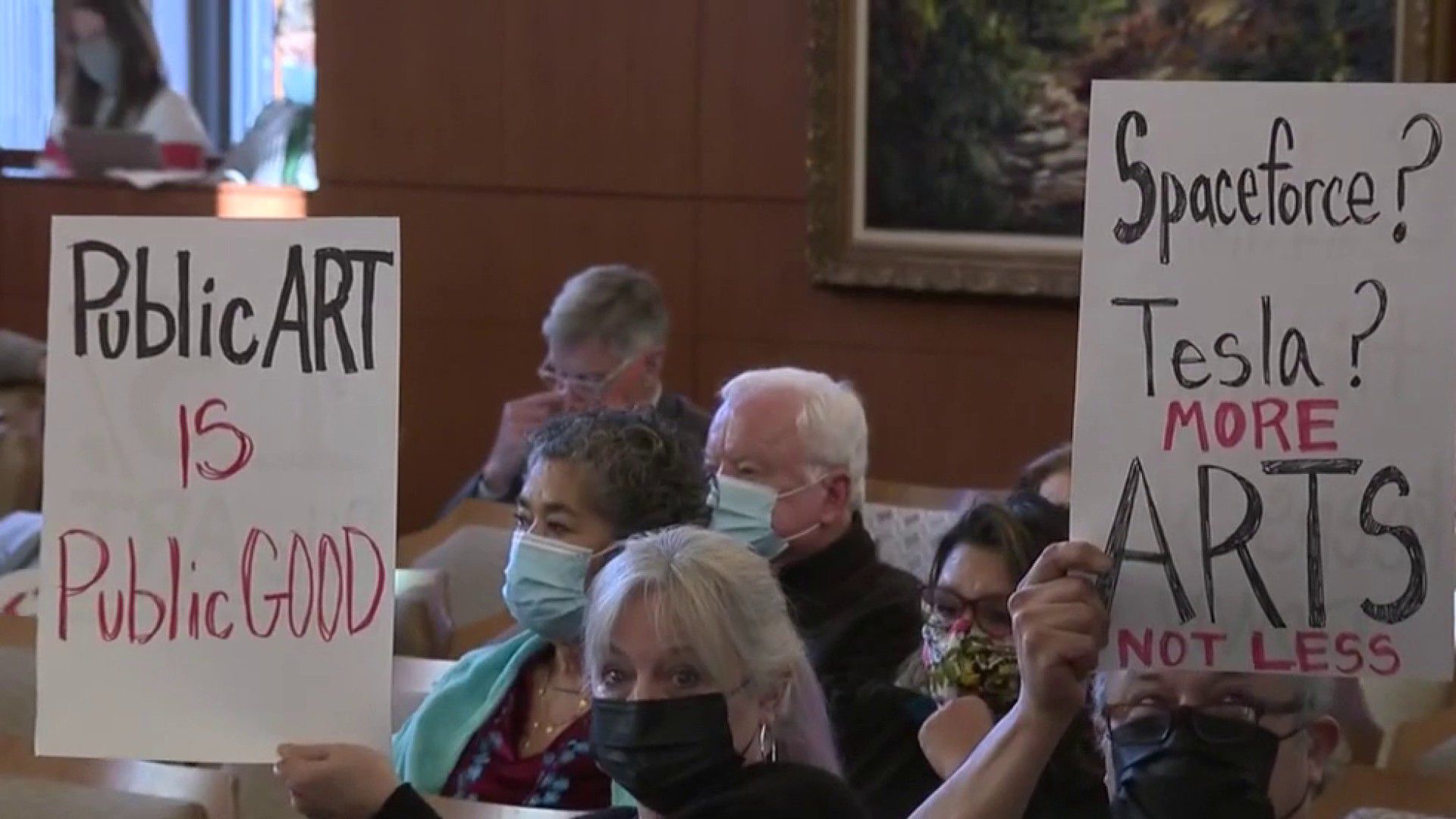
It was an unwelcome change, though, to arts supporters who held up signs during council discussion, and voiced their ire from the podium during the citizens-to-be-heard session following the council discussion.

“If we had known that art – the 1.5 percent art – was on the block, we would have been there,” said one woman. “We would have said something to you. We would have compelled you to hold by your word.”

The council members still could “hold by (their) word,“ as that speaker suggested.

The committees’ project lists are just recommendations; it’s council members who have the final say on what gets packaged into the bond proposal.

If council members want to bring the public arts funding back up to 1.5%, they can, though it could require cutting other projects out.

District 1 Councilman Mario Bravo seemed torn between sticking to the recommendations the bond committees had been tasked with providing, and providing more funding for public arts.

“I want to work with you, Erik Walsh on how we can find other ways,” District 1 Councilman Mario Bravo told the city manager during the council’s discussion. “While I’m hesitant to undo things. I want to work with you on seeing how we can find more funding for the arts.”

Council members suggested possibilities from freeing up more money by funding projects with federal dollars from American Rescue Plan Ac tinstead, to straight cuts of bond projects, to putting more of a focus on arts funding in the annual budget.

Walsh told reporters after the meeting that he planned to provide options to council members, who are scheduled to vote on a final project list on Feb. 10.

Once they approve a bond proposal, it will be put in front of voters as a series of propositions in the May 7 election.

Walsh also noted the $11.8 million the bond committees recommended for public art is still $3.6 million more than what was in the 2017 bond.

New Business Leads – Collected week of January 7, 2022

New Businesses New business licenses and corporate formations. -Sales Tax Permits Company: SA Botanicals Inc., Address: 18154 Blanco Rd. #104, City: San Antonio, State: TX, Zip: 78232, Phone: 210-233-8878, Type: retail-miscellaneous, Sic: 59, Recdate: 2021-12-16, Jurisdiction: Bexar County Company: Effie’s BBQ & Seafood, Address: 1914 Odessa Dr., City: San Antonio, State: TX, Zip: 78220, Type: retail-miscellaneous, Sic: 5963, Recdate: 2021-12-16, Jurisdiction: Bexar County Company: De Valdivia,…

Court Records – Collected week of January 7, 2022

Judgments Legal judgments filed or recorded in local county offices. -Abstracts of Judgment Type: A, Business or Person: B, Plaintiff: Felipe Garcia-Ghinis MD, Defendant: Ruben Gaytan dba Gaytan Heating and Air Conditioning, Defaddr: 219 Tango Dr., Defcity: San Antonio, Defstate: TX, Defzip: 78216, Amount: $27,400, Winner: plaintiff, Caseno: 2021CV02733, Bookpage: 20210349150, Filedate: 2021-12-13, Recdate: 2021-12-16, Jurisdiction: Bexar County Type: A, Business or Person: B, Plaintiff: Pawnee…

Registering voters for March Primary takes on greater significance, activists say

Groups focusing on registering voters ahead of the Jan. 31 deadline for the March Primary have said their efforts have taken on a greater significance.

“There’s never been a more important time to be in voter registration or to be a voter,” said Charlie Bonner, spokesman for MOVE Texas, which has been mobilizing and registering college students statewide since it began at UTSA in 2013.

“It’s really important that voters know that that card is the political autonomy that they have for their freedom, for their voice and for the future of democracy,” said Kimiya Factory, founder and executive director of Black Freedom Factory, which is dedicated to data driven activism and advocacy. Part of its mission is registering voters.

Each said their groups are motivated by last year’s passage of voter restrictions by the Texas Legislature and the continued push for federal voting rights legislation to counter similar efforts nationally.

Considered long overdue by civil rights advocates, President Joe Biden voiced his support for ending the filibuster in order to advance the legislation.

“In Texas, we have always had these challenges. It is not new for us,” said Lydia Camarillo, president of the Southwest Voter Registration and Education Project, founded by civil rights pioneer Willie Velasquez. “We’ve been fighting this since we opened our doors in 1974.”

SWVRP is one of several civil rights organizations suing over what they say are the state’s efforts to suppress the vote.

“Anytime that there are laws that hurt rather than enhance participation in America’s democracy, it hurts,” Camarillo said.

SWVRP also has challenged redistricting efforts through the years.

“The way you fight right now is by registering and turning out to vote in the primaries and in the generals. And don’t forget the runoffs, there’ll be runoff elections,” Camarillo said.

Bonner agrees

“We have to keep fighting, and fighting includes showing up and casting that ballot even when they make it difficult,” he said.

Also on KSAT.com:

The races to watch in Bexar County for 2022 electionsBexar County Judge candidates tell KSAT why they’re runningLast minute campaign announcement creates opening for Bexar County commissioner in Pct. 3. What happens next?Biden on voting rights passage: ‘I’m tired of being quiet!’

Some San Antonio senior citizens defy the odds during COVID-19 surge

As Bexar County gets ready to hit the grim number of 5,000 deaths in the COVID-19 pandemic, one group of high-risk individuals is defying the odds.

While senior citizens are at highest risk for complications due to the virus, there’s a group of them at Blessed Angels Community Center in San Antonio that are figuring out how to live with it, even in this latest surge of positive cases.

The group meets twice a week for exercise, medical checkups and bingo, but also for restocking their kitchen cupboards and COVID booster shots. Amid all the business, there’s socializing, eating, celebrating, and fun.

They are all fully up to date on their vaccines, but while on a couple of them have contracted the virus over the last two years, they have watched younger family members suffer and die. Willie May Gray is one of them, having lost her adult son.

“He had just turned 54, and I just lost him four months ago today,” said Gray, who added that her son was fully vaccinated and he had no underlying medical conditions.

Marty Villareal can relate to what happened to Gray. Her son’s family was hit hard by COVID, and among the casualties was her beloved 29-year old granddaughter.

“She walked into the hospital, but she never came out. She passed away,” Villareal said with tears in her eyes. She, and others at Blessed Angels, said they don’t understand why they have survived while their younger family members have not.

“I tell my other children to get vaccinated, get their shots, wear your mask and try to stay safe,” Villareal said.

The emotional losses have been rolling in for more than a year, but the seniors credit the community center for keeping them healthy, not just physically, but mentally too.

“It helps me so much being here with all these people. If it weren’t for coming out here it would just be hard,” Villareal said.

There’s a feeling of being in it together that is woven into the practicality of visiting Blessed Angels. It’s got an in-house store packed with staples that have become hard to find these days. While spaghetti and toilet paper may be a hit or miss find at local grocery stores, the San Antonio Food Bank and the center’s shopping trips to local stores complete the weekly offerings to these seniors. Many of these clients are caring for their grandchildren, so they rely on these perks.

“I’ve got my booster and I’m raising my 6-year old grandson and he’s had is first and second shots, and last week we got tested and were negative,” Gray said. At 82, Gray is at high risk but feels she needs to mingle with people her age.

The center’s director, Marion Thomas said she’s had to change a few rules. Instead of a “take all you need and want” rule in the store, there are signs now that limit each center client to one or two products each.

“That’s our goal, to help them all that we can because they can’t get around, so we try to bring it to them,” Thomas said.

That goes for their health care too. Everyone is vaccinated, masked, distanced, and when the last bingo number is called, a team of volunteers sanitizes all the surfaces.

Also on KSAT.com:

Some immunocompromised people will be eligible for 4th dose of COVID-19 vaccine this monthComal County reports 379 new cases Wednesday, another new recordWho’s required to get vaccinated in Texas? Here’s what you should know

Metro Health reports highest new COVID-19 case count in Bexar County since pandemic began

San Antonio Metropolitan Health District is reporting its highest single-day COVID-19 case count since the pandemic started with 7,704 new cases on Wednesday.

Wednesday’s COVID-19 Numbers

Metro Health’s COVID-19 dashboard reported a 7-day moving average of 4,352 cases. There were three new deaths reported, according to the data. Thirteen new deaths have been reported over the past seven days.

ALSO ON KSAT.COM: 5 charts show COVID-19 surge in San Antonio

There are 958 COVID patients in local hospitals with 201 in ICU and 79 on ventilators. Metro Health’s dashboard shows there are 10% of staffed beds available and 67% of ventilators available.

On Tuesday, Metro Health’s dashboard reported a 31% positivity rate for this week, a 3.7% increase from the 27.3% reported last week.

See more of today’s COVID-19 statistics and city resources for the public here.

KSAT Q&A: Mayor Ron Nirenberg discusses omicron surge and its impact on city services

San Antonio Mayor Ron Nirenberg joined Wednesday’s Q&A on the 6 p.m. News to discuss the omicron surge and what impacts it has on city services, as well as vaccination talks to get more students innoculated.

When asked about the lower vaccination rate among children in our area, Nirenberg said he and Bexar County Judge Nelson Wolff met with district leaders to discuss better messaging for local families.

“The judge and I convened with the superintendents today to talk about that and the importance for us to get the message to families that are 5- to 11-year-old population, which was the last to become eligible with the vaccinations, still has a lot of room to improve, and we know those students are back in school,” Nirenberg said. “And so to protect them, we need to make sure that they’re getting vaccinated.”

Nirenberg encouraged parents to get vaccines for their children now that school is back underway, putting them at more risk for exposure.

“So if you are a parent of a child who’s between 5 and 11, you are eligible for the vaccine, and you should go get it to protect them in the school setting to make sure that, again, they’re not at further risk for severe infection,” he said.

The mayor said omicron COVID-19 cases have affected city staff members, but services have not been impacted so far.

“The omicron variant has also hit city staff and emergency personnel, and so we have seen staff ranks suffer, but it has not affected the delivery of city services. Thankfully, not yet,” Nirenberg said.

Nirenberg said employee COVID-19 cases are at the highest numbers seen since the pandemic began.

“We’ve seen a little bit of a drop in the number of positive cases this week compared to last, but we are very close to that. In fact, we are at the highest numbers we’ve seen in terms of infections among employees, and we’ve got to watch that very carefully to make sure that it doesn’t impact city services,” he said.

Watch the entire Q&A with Mayor Ron Nirenberg in the embedded video player above.

City health officials offer the following testing guidelines

Consider using a self-test before joining indoor gatherings with others who are not in your household.A positive self-test result means that you have an infection and should avoid indoor gatherings to reduce the risk of spreading the disease to someone else.A negative self-test result means that you may not have an infection. Repeating the test with at least 24 hours between tests will increase the confidence that you are not infected.Ask your health care provider if you need help interpreting your test results.

Click here to access more information about other city no-cost testing sites.

Also on KSAT:

Here are the COVID-19 vaccine pop-up clinics taking place around San AntonioWhere to get tested for COVID-19 in San Antonio, Bexar CountyWhere to get a COVID-19 vaccine in San Antonio

San Antonio City Council to vote on CPS Energy rate hike Thursday

The San Antonio City Council will vote on a CPS Energy rate hike proposal this Thursday after the CPS Energy Board of Trustees unanimously approved the 3.85 percent rate increase earlier this week.

The board also approved a regulatory asset, which the utility says will recover $418 million in fuel costs from last February’s winter storm.

The rate hike has been expected for several months, and while it’s lower than the double-digit percentage increase the utility originally wanted, many customers still have questions. Here are some of the answers:

1. HOW MUCH IS IT?

The proposed rate hike is comprised of two parts: a 3.85 percent increase to the base rate and establishing what the utility calls a “regulatory asset,” which would show up as an increase to your fuel adjustment charge.

How hard these two factors would hit you depends on how much power and gas you use. CPS Energy estimates the average electric and gas customer would see a $5.10 increase to their monthly bill, a 3.3 percent impact.

Those who use 2,000 kWh of power and 50 CCF of natural gas each month, though, could see a $9.35 bump every month — about 3.5 percent more than their current bills.

As part of its rate requests, CPS Energy also proposes to expand its affordability program by another 14,000 customers — up to 65,000 customers total — and increase the discount customers receive enough to offset, on average, the base rate portion of the tax hike.

2. WHAT’S IT FOR?

Officials say the rate hike proposal is about covering immediate financial pressures.

The increase to the base rate is expected to generate about $73 million more every year for the utility, which it says would be used for making infrastructure more resilient to extreme weather, planning for more regulatory requirements, planning for replacing their old computer systems, and staffing.

Meanwhile, the bump in the fuel adjustment charge would cover — over 25 years — the $418 million the utility has already paid out for fuel and related costs incurred during the winter freeze.

CPS is still fighting another $587 million worth of costs from the freeze, which are not included in the calculations for the rate adjustment.

The rate hike does not take into account all the money customers still owe from the pandemic either, as it is waiting to see how many customers start paying up once they’re faced with disconnections.

The increase does not include any changes to the rate structure or cost assumptions for any strategic decisions on generations, either, such as shutting down or converting its coal-power Spruce plant.

3. WHAT WAS IT ORIGINALLY?

CPS Energy had originally proposed a much larger hike, about 11.1 percent overall, including a 13.4 percent hike to the base rate.

Many more things were bundled into the original draft, including recuperating the “bad debt” from then-unpaid customer bills and more of the fuel costs from the February freeze. It also took into account decisions on what to do with the Spruce 2 coal power plant and other power generation issues.

City staff received that draft proposal in September but suggested the utility take a different route, focusing on a pared-down request that only focuses on known costs. City staff say they worked “collaboratively” with the utility to develop the new proposal that is now up for approval.

4. WHEN COULD IT HAPPEN?

If approved by the San Antonio City Council on Thursday, the new rates would take effect March 1, 2022.

5. WHEN COULD IT HAPPEN AGAIN?

It has been eight years since CPS customers had a rate hike, but utility officials have made it clear they don’t intend to wait that long again.

The city council approved a 4.25 percent bump to the electric and gas base rates in November 2013, which took effect February 2014.

If the council approves this increase, utility officials have said they plan to do new rate evaluations every two years.

A CPS presentation to council showed 5.5 percent base rate increases in FY 2025 and FY 2027, though officials said those are just “placeholders” and those numbers will be refined as those times get closer.

Officials say the Rate Advisory Committee, which is composed of council and CPS board appointees, also need time to consider possibly restructuring the rates for how customers are billed, as well as strategic decisions on how the utility generates power.

MORE INFORMATION

In its efforts to justify the proposed rate increase to customers, CPS Energy has invited customers to visit its Proposed Rate Case website or call 210-353-2222.

The website lays out the utility’s reasoning for the rate hike and has upcoming events, including a Dec. 13 board meeting and Dec. 14 tele-town hall, which have opportunities for public input.

ALSO ON KSAT.COM

CPS Energy’s Board of Trustees approves 3.85% rate increase

Some immunocompromised people will be eligible for 4th dose of COVID-19 vaccine this month

Some immunocompromised people in San Antonio will be eligible to receive a fourth dose of the COVID-19 vaccine this month.

The fourth dose is the booster for people who have already received three shots of the primary dose of either the Pfizer or Moderna vaccine.

The CDC recommends that people who are immunocompromised get three primary doses (instead of two) followed by a booster shot five months later. This population is the only group eligible to receive four vaccine doses at this point.

People are considered to be moderately or severely immunocompromised if they have:

Been receiving active cancer treatment for tumors or cancers of the bloodReceived an organ transplant and are taking medicine to suppress the immune systemReceived a stem cell transplant within the last 2 years or are taking medicine to suppress the immune systemModerate or severe primary immunodeficiency (such as DiGeorge syndrome, Wiskott-Aldrich syndrome)Advanced or untreated HIV infectionActive treatment with high-dose corticosteroids or other drugs that may suppress your immune response

People who fit that criteria were eligible to receive a third primary dose of the Pfizer or Moderna shots 28 days after their second shot. That third dose happened as early as August here in San Antonio, making them eligible for a fourth dose — their first booster —at the end of this month.

“In this group, adults (18+) should get a booster (4th dose) of mRNA vaccine 5 months after their 3rd primary dose,” said Dr. Jason Bowling, an epidemiologist at University Health in San Antonio. “12 to 17-year-olds can get a Pfizer booster (because) Moderna is not yet approved for these ages.”

Anyone who got the Johnson and Johnson vaccine should get a booster two months after the first dose.

Dr. Jason Bowling explained to KSAT that the vaccine recommendations continue to evolve. The latest recommendations can be found on the CDC’s website.

City health officials haven’t officially announced the availability of this booster for the immunocompromised. We will give an update when that information is provided.

Also on KSAT:

Where to get tested for COVID-19 in San Antonio, Bexar CountyWhere to get a COVID-19 vaccine, booster in San AntonioHere are the COVID-19 vaccine pop-up clinics taking place around San AntonioSan Antonio school districts lay out COVID-19 policies as cases continue to surgeWho’s required to get vaccinated in Texas? Here’s what you should know

Brother of ‘Hispanic Elvis’ speaks out as beloved San Antonio icon is hospitalized and ‘very sick’

The San Antonio icon known only as Hispanic Elvis has been hospitalized and remains in serious condition, his brother confirmed to KSAT on Wednesday morning.

George Cisneros tells KSAT his brother has “an infection in his esophagus” and says he was told on Monday that his brother was “very sick.” Cisneros said he was also told by doctors that his brother tested positive for COVID-19 so he has been unable to visit him at the hospital over the past two days.

News of Hispanic Elvis’s condition surfaced this week on social media with dozens of people have sharing photos, stories, prayers and memories of the man who has entertained crowds at Market Square for more than two decades.

Cisneros said his brother is “very private,” but he and his family “appreciate all the support” and the prayers he’s received over the past two days. “I know a lot of people love him,” said Cisneros.

He added that he wanted to thank the Cortez family for allowing his brother to be inside Mi Tierra all these years and thanked the owners of a nearby michelada stand for allowing Hispanic Elvis to perform and meet visitors in their area.

Hispanic Elvis, 76, was born and raised on the city’s West Side. Cisneros said they grew up in a small house behind the Guadalupe Cultural Arts Center.

While many people are aware of his current persona as Hispanic Elvis, Cisneros said his brother played guitar in a band in the 1960s, performing at historic venues like Patio Andaluz near downtown.

Cisneros said his brother always had a penchant for wearing nice clothing and would buy his clothes at Penner’s. He said that his brother liked the way Elvis dressed, but was “more of James Brown fan,” noting he would mimic Brown’s dance moves during performances.

Before he spent the majority of his time at Market Square, Cisneros said Hispanic Elvis started his street performances in the front of the Alamo and would like to pose as a mannequin in front of Ripley’s Museum to have fun with visitors.

In September, local artist Colton Valentine paid tribute to Hispanic Elvis by painting a mural of the man on San Pedro Avenue. The mural shows Hispanic Elvis riding his bicycle, a common sight near downtown and the West Side, with his homemade guitar, sunglasses and flashy attire. “I’m so grateful to the artist who drew that mural,” Cisneros said.

Hispanic Elvis does not have a cell phone and Cisneros said he “was old school like that.” And despite many opportunities to cash in on his popularity, Cisneros said his brother turned down multiple offers to star in commercials, saying his brother lives by his own rules.

“My brother is living his dream, he didn’t want to make commercials or be more famous,” Cisneros said. “He just wants to entertain people.”

Do you have a memory or picture with Hispanic Elvis. Share your memories or well wishes in the comments of this story. You can upload your picture here ksat.com/pins. We may use your photo in a gallery or on our newscasts.

We also discussed the social media tributes the influence “Hispanic Elvis” has had on San Antonio residents in this morning’s KSAT News Now. Watch Wednesday’s show here.

Iranian film A Hero stretches its thin story to the brink

For fans of international films, Iranian filmmaker Asghar Farhadi has been a reliably good storyteller. Two of his films — 2011’s A Separation and 2016’s The Salesman — won the Oscar for Best Foreign Language Film (now named Best International Feature Film), and his other films have been well- regarded and rewarded with a slew of honors. His latest film, A Hero, is a morality tale that is as well made as his other films,…